

Anyone who knows me will tell you I’ve always been an admirer of the literary giant, Ernest Hemingway, and his lasting impact on the art of literature. Last month, I got to read through his posthumously published novel Islands in the Stream (not to be confused with a song from the Bee Gees) that I thrifted from a local Philly bookstore.

Islands in the Stream tells the story of Thomas Hudson, a US naval veteran, fisherman, expatriate, and once-family-man, who paints alone while reclused on the island of Bimini in the Bahamas. Written in usual Hemingway-style – that is to say, stoic, succinct, compelling – it offers a great deal of insight into Hemingway’s own life and perhaps the lives of many veterans at the time and men who had trouble dealing with grief and the powerful emotions welled up inside them.
The most impressive technique used in Islands in the Stream is the prevalence of three-act structure. Literally divided into three parts, the book in its entirety represents three walks of life. This may not have been intentional on Hemingway’s part though, but by his fourth wife Mary Hemingway and his editor Max Perkins, who found a “sea trilogy” of stories revolving the stoic seafarer Thomas Hudson and transformed them into the book we now know as Islands in the Stream.
Originally titled as “The Sea When Young” (Bimini), “The Sea When Absent” (Cuba), and “The Sea in Being” (At Sea), each collection represents a different side of Thomas Hudson, and (whether intentional or not) offers a lot of insight into what Hemingway aimed to achieve with the character.
Each act has a significant inflection point. Tom learns about the death of two of his youngest children at the end of act one, just after they had visited Tom in Bimini and spent a great deal of time. The second act ends with Tom heavily drinking and sleeping with women to expunge the pain of his grief. The third act takes place almost entirely at sea on an auxiliary patrol boat where Tom and his crew search for German war prisoners escaping through the channels of Cuba.
Due to the nature of how the book was put together combined with Hemingway’s already ambiguous storytelling style, the plot can be a bit dynamic in how rapidly the story progression changes. Hemingway was never one for writing intricate plots though. He was one to write things as they are, sometimes too direct, too succinct, and too close to home for the thousands of war vets from the Lost Generation who, like Thomas Hudson and Hemingway himself, became disillusioned and reclusive.
- Aside: There was also an English portrait painter in real life also named Thomas Hudson, though it is not at all certain if that had any influence on the naming of the character.
Hudson’s stoic-yet-tragic nature is where Islands in the Stream really becomes fascinating. He is almost a striking commentary on masculinity, both its peaks and its valleys. He is a man of many talents: a gifted painter, a genuine storyteller, a dedicated fisherman, and avid adventurer.
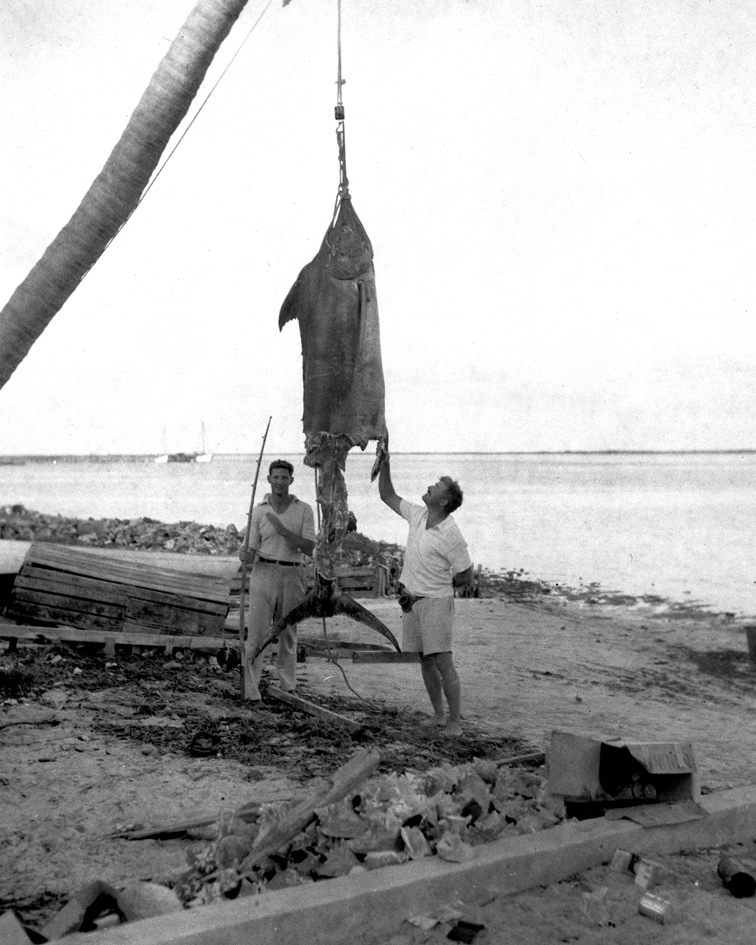
Some have drawn the inference that Tom’s affinity for painting is influenced by Hemingway’s acquaintance with Pablo Picasso, but it is actually more likely the influence came from Henry Strater, an American painter and fisherman, who actually spent a summer with Hemingway on Bimini. On the left, Strater and Hemingway are standing beside a 1,000-pound marlin.
Bimini
In the first act “Bimini”, Tom’s in bliss. A tropical island, painting at leisure, a family man and war hero? He had reputation, he had legacy, he had everything the idyllic traditional American male ever dreamed of. However, this tranquil lifestyle comes with its own peaks and valleys.
We find out Hudson is a rather lonely fellow, like most stoic masculine men are. Bottling up emotions, unable to communicate feelings, and swallowing up the horrors of war and solitude with a shot of whiskey. “Whatever happened to guys like Gary Cooper, the strong, silent type?”
Even with that, there is still a charm to Tom. While there are certain flaws to that “old-school” masculinity, there is a beauty to it as well. Tom is a man of great strength and intelligence, he’s funny and while he may not be a saint among men, he still has a discernable moral true north.
We are also introduced to Roger Davis, a foil to Thomas. We learn that Roger is also lonesome and hides a much deeper, personal trouble, but Tom and him have a mutual respect.
Accompanied by his three sons, as well as other various characters, we learn a great deal about Tom’s comradery and sense of companionship. The scenes are rich and largely expressive, as the boys fish and drink together with Tom and it reads like a joyous, action-filled summer vacation. It is reminiscent of the scenes in Hemingway’s acclaimed novel A Farewell to Arms after Henry and Catherine escape into Switzerland after the harrows of war and enjoy a pleasant last few months during Catherine’s pregnancy.
But… like many Hemingway characters, happiness is short-lived. Soon after the boys leave the island, Tom receives a radio transcript that informs him his two sons and their mother had died in an accident after leaving Bimini.
Outliving one’s own children is a sorrow I wouldn’t wish on my worst enemy. Yet it is a devastating reality for certain parents in the world. Gerald and Sara Murphy, a wealthy American couple who were friends of literary giants like Hemingway and F. Scott Fitzgerald, had lost their son to illness, and it no doubt played a part in influencing the narrative of Islands in the Stream.
Cuba
Grief, and how we deal with it, is something that has persisted since the dawn of man. If generations upon generations could not answer it, if religion could not answer it and the passing of time, then clearly, we know it’s not an easy fix. However, there’s still right ways and wrong ways to deal with grief, and Thomas Hudson’s battle with it is a tragic one.
Called off patrol duty in Havana, the reader learns Tom’s last son, Thomas Hudson Jr. whom he loved the most, was killed in action during the war.
Tom decides to go to the bar to soothe his troubles. The most visceral part of reading this second act for me were the rounds upon rounds of strawberry daiquiris and flirting with various women and recounting the numerous romantic escapades.
The section ends with Tom back in naval reconnaissance.
At Sea
The last act of this book takes a drastic turn from the first two. We cut to Thomas Hudson and a crew of misfits chasing down German fugitives, or “Krauts” as Tom calls them, in the archipelago of Jardines del Rey.
Out of the three acts, this portion of the book deals with high-octane naval action, military espionage, and an emphasis on comradery.
Hemingway gives us an ambiguous ending when Tom is wounded in the gunfight with the Germans without clarification of whether or not Tom survives. My personal theory is that Tom did in fact die in that moment, but finally could come to terms with the grief he’d suffered with for so long.

For a more critical lens of the review, the prose in Islands in the Stream is not as clean as I would have liked, but this is likely due to the fact that Hemingway did not forego much of the proofreading and copyediting himself. Max Perkins was a literary giant himself (who I’ll be sure to write a full blog in dedication to him as well), but even he was no Hemingway and could not edit precisely in his style so long after Hemingway passed.
The intention behind publishing Islands in the Stream was to revive Hemingway’s career after mixed reviews from his late works. Hemingway had lost himself in the end, but he will always be renowned in the literary world for his unique voice, his ever-famous iceberg principle, and unwavering impact on American literature.
 Donovan Levine | Agent, Writer, Copyeditor
Leave a comment