

One of my favorite literary devices is the foil character. I can’t put my finger on exactly why, but my hunch is that most foils work towards a more satisfying resolution for our protagonist’s arc.
What I mean by this is, say, if you have two foils whose stories are closely intertwined, their resolutions will likely mirror one another, and serve to enhance the character traits of our hero.
A foil character is someone whose traits, values, emotions, or motivations directly contrast with that of another character (usually the protagonist, but not always). You see them a lot in Shakespeare and that’s probably why you learned about them in middle school English class, but foils are actually all over literature and pop culture:
- Luke Skywalker and Han Solo (Star Wars)
- Ahsoka Tano and Asajj Ventress
- Yoda and Sidious
- Harry Potter and Draco Malfoy (Harry Potter)
- Billy Costigan and Colin Sullivan (The Departed)
- Jack Walsh and Jonathan Mardukas (Midnight Run)
- Tyler Durden and the Narrator (Fight Club)
- Elliot Alderson and Mr. Robot (Mr. Robot)
- Elliot Alderson and Tyrell Wellick
- Darlene Alderson and Dominique Dipierro
- Gustavo Fring and Walter White (Breaking Bad)
- Saul Goodman and Walter White
- Jesse Pinkman and Walt Jr.
- Musashi Miyamoto and Sasaki Kojiro (Vagabond)
- Spike Spiegel and Vicious (Cowboy Bebop)
- Spike and Andy
- Guy Montag and Clarisse McClellan (Fahrenheit 451)
- Elizabeth and Jane (Pride and Prejudice)
- Macbeth and Macduff (Macbeth)
- Macbeth and Banquo
- Mercutio and Romeo (Romeo & Juliet)
- Mark Antony and Brutus (Julius Caesar)
- Nick Carraway and Jay Gatsby (The Great Gatsby)
- Tom Canty and Edward Tudor (The Prince and the Pauper)
- Paul Atreides and Feyd-Rautha Harkonnen (Dune)
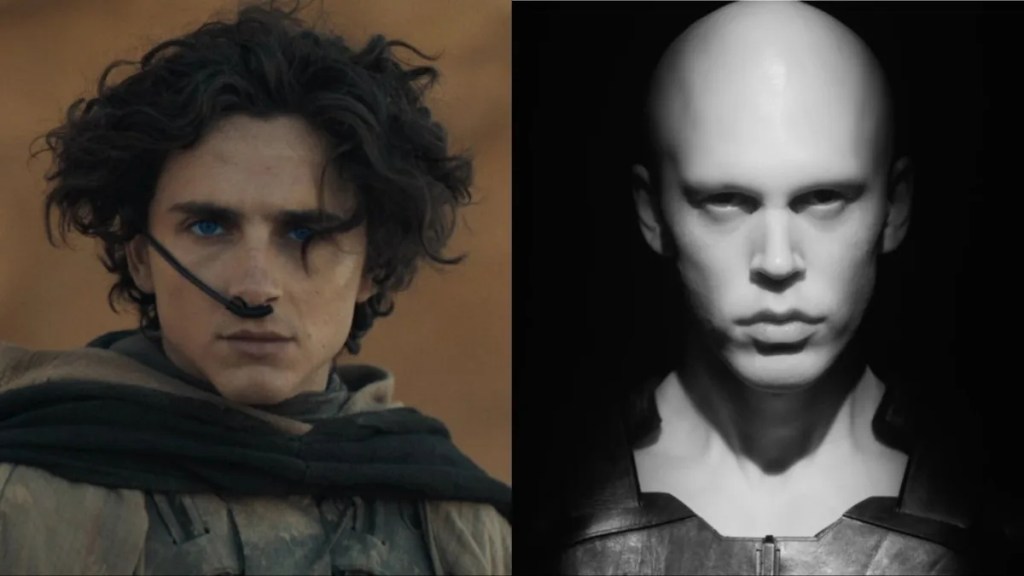
How are foils used in novelwriting?
Foils don’t necessarily have to share a protagonist/antagonist dynamic, but in many cases, foils will be at odds with each other.
Whether they are enemies or frenemies, dichotomies or rivalries, these sorts of characters stick with us, probably because we may have people like that in our lives, whether it’s someone we genuinely hate, or on a less intense note, someone whom we share characteristics with, but hope to surpass one day or break away from.
Perhaps we want to secretly prove them wrong or show them how their life could have been different by our own way of life. It sounds a bit superficial, but I’ll go out on a limb to say you may have someone like that who fits the bill.
Take Tom Canty and Edward Tudor in Mark Twain’s The Prince and the Pauper for instance, the former being a poor man hungry and loitering on the streets of Offal Court, and the latter being the Prince of Wales.
After they each switch clothing inside the palace chambers after Tom was nearly beaten by the palace guards (the real enemy of the story, clearly), they no longer recognize their beloved prince and confuse him for Tom.
The once-prince must now live like a commoner, and the once-commoner must now live like a prince. Edward becomes aware of the commoner’s struggle while Tom becomes cognizant of regal responsibility.
Their diametrically opposite storylines compliment the lesson in each, and Twain’s not-so-subtle statement on class struggle and shedding a light on the privileges of the upper classes.
Without this dichotomy, this foil, the story would have failed. Were Twain to write solely from the perspective of Tom or solely from the perspective of Edward, given Twain’s caliber, it still probably would have been a good work, but it never would have been the classic work of literature we know it as today.
Foils are an awesome literary device, like I said, and not only do they help with the overarching narrative of a story, or enhance the protagonist, but they also serve a functional role in story structure. And to me, there’s few better examples of this than Feyd and Paul from Frank Herbert’s Dune.
How Dune uses its foil characters
* Spoilers ahead *
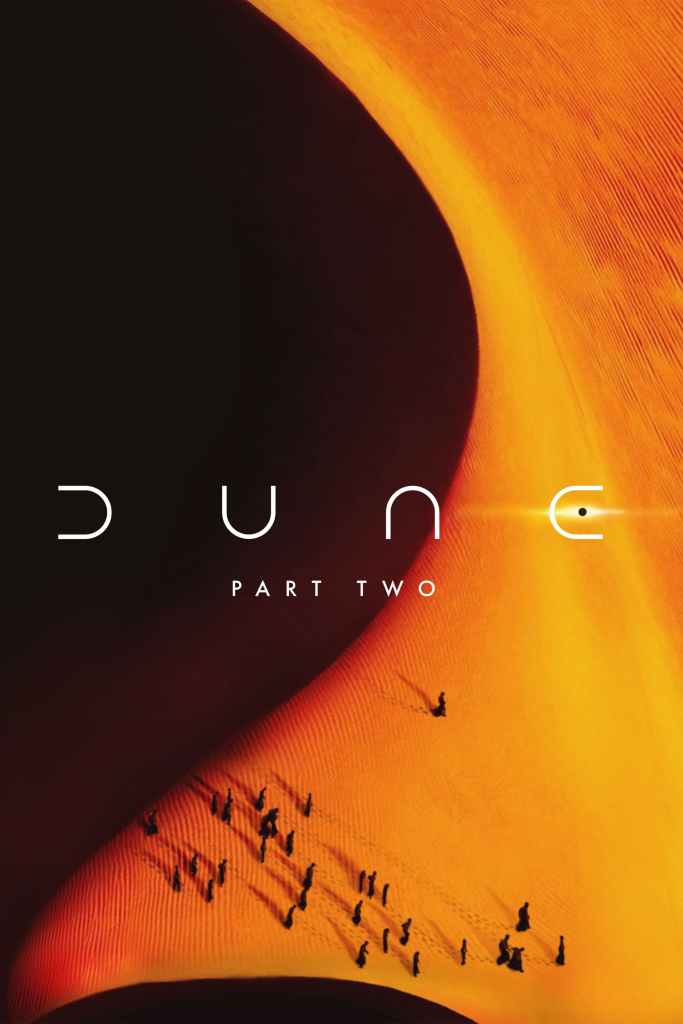
Walking out of the theaters after seeing Dune: Part Two by Denis Villeneuve, I was left star-struck by the phenomenal storytelling of Frank Herbert once again.
As a newer Dune fan, watching this was an amazing, visceral sci-fi experience that left me disappointed to leave the world of Arrakis and back to my boring reality.
That’s always been the power of immersive sci-fi fantasy: an escape from society.
Like most fiction, stories let us share the imagined lived experience of someone else, but Dune allows you to envision entire new worlds and experiences so far removed from our own that stays in little pockets of our brains to come to whenever reality gets too painful.
There’s a lot of central storytelling themes in Dune that would take me several blog posts to truly dive into, but the one that seem to stand out for me in Denis Villeneuve’s Part Two is the character of Feyd-Rautha Harkonnen, the nephew of the “big bad” villain Baron Vladimir Harkonnen.
The reason for this, I suppose, was Villeneuve’s choice to split the original Dune book, a book that spans over 900 pages compared to the sequel counterpart Dune: Messiah which clocks in at around 350 pages, which allowed the story to breathe a bit more and grant us nearly six hours of beautiful, on-screen Dune experience.
And having read the first Dune book, Feyd’s character almost becomes the main character of the second half. Where Paul’s exposition has mostly wrapped up in Dune: Part One, and all that’s left is his Fremen training and unlocking his prescient vision, the rest of the exposition (and following rising action) is spent developing Feyd’s rise to power.
Our first introduction to him is in a gladiator arena, where we see a cold, ruthless, and frankly psychotic iteration of the character. A striking difference compared to the Sting performance in Lynch’s Dune, and in some ways a bit different from the books too.
Feyd was no doubt evil in Herbert’s original Dune, and he certainly was a naturally gifted fighter and slayed many enemies. Already, we see where he is a foil to Paul, as despite being trained by the feared general Gurney Halleck and already being a formidable fighter, Paul had never killed anyone until his encounter with Jamis on Arrakis.
The major striking similarity between Paul and Feyd is their intertwined destiny, as both were born as a result of thousands of years of breeding and carefully coordinated bloodlines being passed down through generations as a plot by the dark sisterhood, the Bene Gesserit.
This lineage was meant to create something known as the “Kwisatz Haderach” a being capable of controlling time and space. Given the magical elements of spice, Guild navigators, and advanced technology of Herbert’s futuristic world, a being such as this isn’t too far-fetched, but it needed a merger of two noble families with a long history of bloodshed.
Feyd and Paul are cousins, by this merit, which makes the Bene Gesserit “master plan” even more creepy and insidious, as we learn that Lady Jessica (Paul’s mother), was meant to bear a daughter who would mate with Feyd to bear a son that would be the KW the Bene Gesserit desired.
But Jessica thwarted these plans by bearing a son instead (since using their powers, they can alter their DNA and thus alter their unborn child’s sex), making Paul a KW candidate and leaving Feyd to mate with another potential candidate (in DV’s Part Two, this is done through impregnating the Lady Fenring, although this does not happen in the books).
Feyd vs Paul
How different their destinies could have been if Paul were born a woman instead of a man. Instead, Paul, exiled from his home world, takes advantage of the religious legends spread about a messiah from another world leading Arrakis back to a ‘green paradise’.
With this, he has the overwhelming support of millions of Fremen touting him on to challenge the Emperium itself and trigger a galaxy-wide ‘jihad’ or ‘holy war’.
And via Arrakis, he’ll have control of spice production, the commodity which the whole known universe needs to survive – and a not-so-subtle metaphor for foreign oil. Herbert’s major climax sees Paul combine the threat of destroying all spice as leverage with his birthright as Duke of Arrakis, following the death of his father Duke Leto Atreides, as a claim for the throne.
In contrast, Feyd had won the hearts of the Harkonnen commoner through his feats on the gladiator stage and his fearlessness in doing so.
As the nephew of an heirless Baron, who now – through the betrayal of House Atreides – controls the spice trade and plots to use this advantage as a claim for the throne as well, Feyd is the supreme position to take total control of the universe.
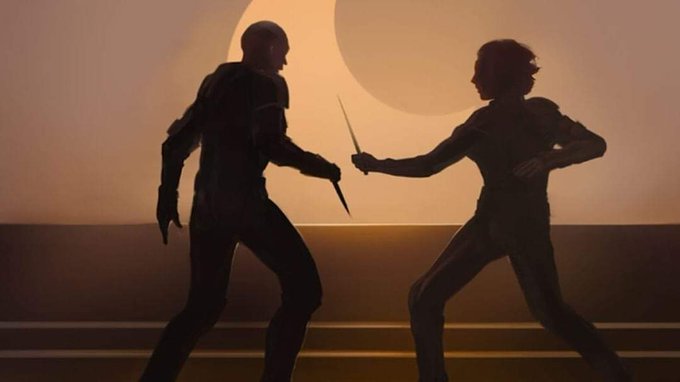
Through the marriage of Princess Irulan, Emperor Shaddam Corrino’s only heir, both Feyd and Paul possess the same route to power, and both these character arcs come full circle in kanly, a duel to the death, that will decide the ultimate fate.
This is yet another reason why DV’s decision to break Dune up into two parts works so well. Ending the first Dune with a kanly, Paul vs. Jamis, and the second Dune with Paul vs. Feyd, each fight leaves us with a varied meaning that ultimately shapes Paul’s character and the narrative tone of the story. Two inflection points which change the course of the book itself.
Paul’s fight against Jamis became his first encounter with a nexus event, a conscious choice of free will that opposed his prescience and possible futures (free will vs. predetermination). It was Paul’s first time taking a life, his initiation into the Fremen culture, and his ‘point-of-no-return’, no longer being simply ‘Paul’ but soon to be ‘Usul’, ‘Paul Muad’Dib’, and the ‘Lisan al-Gaib’.
Paul’s fight against Feyd was a similar nexus event, an event that could have spared the fate of billions across the universe had Paul lost (yet possibly saved humanity from a separate yet greater evil in the later books). Not only have the stakes never been higher for Paul, but all of his trainings between the Atreides military, the Bene Gesserit, and the Fremen have prepared him for this exact match against his Harkonnen cousin and counterpart.
But what does Feyd show us about Paul?
Through Feyd’s shrewd cruelty and sociopathic tendencies, he becomes a twisted mirror of Paul, whose internal reluctance toward unifying Arrakis and the oncoming jihad comes across as empathetic and kind. The merciful heart of the Atreides is why we root for Paul.
Feyd also pivots Paul’s ‘heroism’. Americans should know all too well about the ‘lesser of two evils’ saying, and that applies here too. Paul’s jihad is certainly no heroic act, but a lot of people take the interpretation that Paul is a heroic figure.
This was evident by the initial reaction to Herbert’s publication of Dune Messiah in 1969 when fans felt dissuaded by the idea of Paul being an evil ruler, taking part in a genocide, falling from grace, losing his lover, and meeting a pitiful end.
I won’t necessarily go too deep into this debate, as it’s pretty controversial within the Dune community. Paul’s certainly no villain, but I won’t peg him as a hero either. Does he fit the criteria of anti-hero? It’s hard to say, but much of Paul’s heroic traits are only thought to be heroic when compared to the likes of Feyd and his enemies.
Paul is a victim. He may have been born into privilege and an heir to a mighty noble house in a world full of water, but it ultimately means nothing when the Atreides are vanquished, his new home world is a desert planet, his father had been killed, his closest comrade in Duncan Idaho died saving him, and he is forced into conflict upon conflict in order to survive.
Feyd is the version of Paul where everything goes right. He is the version of Paul that never loses his father, never loses his home world, and never experiences total defeat. He doesn’t struggle, and he doesn’t learn. He inherits power through birthright alone, instead of by the merits of his own actions.
And this is likely why Feyd loses in the end, because unlike Paul, he never had to prove anything to anyone other than his uncle, and he doesn’t possess the same desperate spirit as Paul.
Feyd wants to win, because he’ll be able to rule and do whatever he wants, whereas Paul needs to win, or else everything he worked so hard to protect would have been for nothing.
Meanings within meanings, plans within plans, a feint within a feint. These double entendres are what make Dune such a profound literary book that hasn’t lost its shine since first publishing in 1965.
So, for writers working on their novel, whether it’s science fiction or not, foil characters are a great study in writing characters overall, and the different ways of weaving them into a larger narrative. To enhance the traits of the protagonist, or to better show their signature flaw, learning to write foils may be the best way of taking your writing to the next level.
 Donovan Levine | Agent, Writer, Copyeditor
Leave a comment