

Saltburn is a 2023 psychological thriller black comedy starring Barry Keoghan, Jacob Elordi, and Rosamund Pike. Written and produced by Emerald Fennell (and also Margot Robbie).
There’s certainly buzz around the film given its five BAFTA nominations, two Golden Globe noms, and three Critic’s Choice award noms.
No Oscar noms, once again, for Barry Keoghan, which is a shame given his talent. I don’t think I’ve had this much excitement for an actor’s potential since seeing Riz Ahmed in The Night Of. Not to mention I’m still upset he didn’t win best supporting actor for The Banshees of Inisherin last year.
And in Saltburn, he carries the whole movie. As the leading role this time, Keoghan is captivating, verdant, and (towards the end) outright devilish.Our Titles
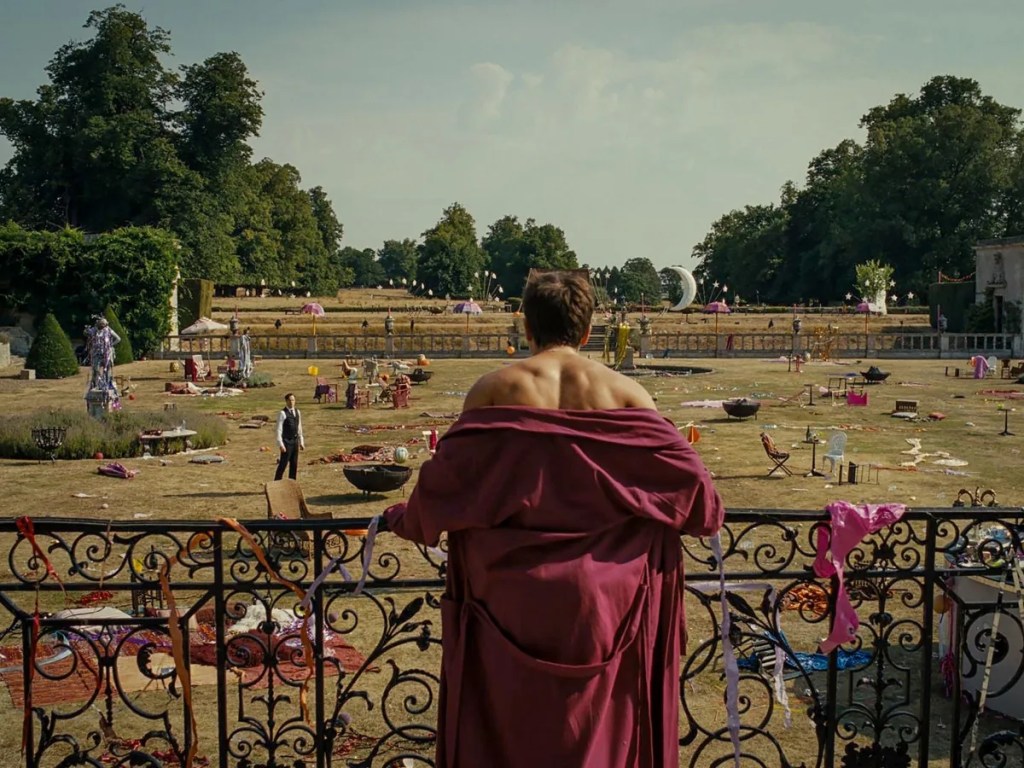
Saltburn carries a bit of whimsy toward the beginning. By whimsy, I mean rich people, eclectic parties, drugs, fantasies, and lust. Oh yeah, mixed with sprinkles and jimmies of gothic scenery and symbolism. A recipe for a pretentious-but-enticing coming-of-age movie, that is until the second act…
The cinematography of Saltburn is absolutely humming. Every shot in this movie looks like it was straight out of a painting, perhaps because of the regality of its mise-en-scène and unique setting, the chiaroscuro (use of shadow and light), and its great framing, it’s a beautiful movie to watch visually.
Story-wise, we run into some key issues. Pacing, characterization, and messaging in this film seem to fall of a bit. I’ll get to that in a moment.
Keoghan plays a character named Oliver Quick who goes to university practically friendless and anti-social. He hits and misses with a few friendships before setting his eyes on the talk-of-the-town, Felix Catton (Elordi’s character).
aside: Elordi, I fear, is getting typecasted. Between Euphoria, The Kissing Booth, and Saltburn, he plays the same stolid, party-boy delinquent. The most I’ve him out of his range was in Deep Water, a movie he was in for probably less than ten minutes.
Anyway, upon befriending Felix by a series of favors (later revealed to be masterminded by Oliver), Oliver and Felix hit it off in a strange yet provocative series of encounters that ultimately lead to an unlikely friendship.
Oliver “confesses” to Felix about his tough home life, lack of friendships, and gloomy habits. Felix, out of pity and perhaps titillation, invites Oliver to his country home in the fictional English town of Saltburn.
And by country home (which is what Wikipedia calls it), I should add it is a ridiculous 127-room mansion known as the Drayton House in real life. And it includes a maze. For fun, I guess.
Felix seemingly keeps forgetting to remind Oliver of his family’s odd traditions and mannerisms to the point of idiocy, but thankfully Elordi’s acting is endearing enough to keep us going at this point.
This midpoint is where the entire focal point of the setting, genre, and story changes. Things get weird. So weird, Carey Mulligan is in the movie and she’s unrecognizable (and unneeded). A far cry from her role in another nominated film this year, Maestro.
There are some bizarre sensual scenes, so bizarre I actually refuse to describe them even in the spoiler section of this blog, but if you’ve seen the film, you probably know exactly what I’m referring to.
*SPOILERS AHEAD*
The remainder of Saltburn is a Gone Girl-esque level of disturbing and connivingly evil sequences for almost inexplicably no reason.
The shock value may pay off at first, but after deeper analyzation of the film and allowing it to settle for a bit, I came to realize I have no idea what Oliver’s motivations were.
If Oliver were merely some sadistic sociopath, was it necessary to come up with something so elaborate and could have backfired any given day? Though, that’s the direction we tend to believe considering his lack of remorse and doubling down on it with ‘the grave scene’.
If it were more of conscious choice, and Oliver was more or less morally astute up until meeting Felix, and upon his jealousy and coveting for Felix, decided to mingle with the whole family. And then, upon meeting this eclectic, wealthy, and privileged bunch, decides to kill them all and take the estate for himself.
This may have been a more logical approach, but because of the twist at the end revealing everything was done by Oliver’s design, it’s clear he was simply insane all along.
Barry Keoghan’s naked dance to the tune of “Murder on the Dance Floor” by Sophie Ellis-Bextor at the end vividly cements Oliver as a completely absurd and maniacal freak. It’s the sort of provocative scene that stays in one’s mind for a long time after viewing, which seems to be the point. Shock value, once again.
But it’s not the gore and disturbing manipulative murders that make me dislike Saltburn. I’ve seen and analyzed enough psychological horrors for it to not really be a palate cleanser for me.
If anything, it actually holds up quite a lot to Last Night in Soho, a horror film written and directed by Edgar Wright, someone who doesn’t usually tamper with this genre.
My problem with the film is that it doesn’t seem to know what kind of story it wants to be. It plays the genres and stories in each three acts so well, but it doesn’t exactly mesh all three together because, well frankly, it’s just inconsistent.
Oliver goes from a timid, anti-social charity case for Felix to being a complete and utter cartoon-villain mastermind who orchestrated the downfall of an aristocratic family entirely on a whim.
With the flash cuts that reveal the “second big twist of the film” that Oliver deliberately sabotaged Felix’s bike, set everything up for him to pay the tab at the bar, and just about every major event of the story, we’re given Professor Sergio Marquina-level of manipulative planning that realistically and logically would have taken years to plan.
Now, we already had an inkling Oliver wasn’t an entirely moral or normal person from the beginning.
In the first act, while still at Oxford, we see Felix make love to another woman while Oliver creepily stands beyond the window while smoking a cigarette. It paints an already twisted view of the character.
Then, the “first big twist of the film”, we find out Oliver was a pathological liar who made up the story about his family. His background was actually happy and pleasant whereas Felix was led to believe he was an only child, fatherless, and his mother a drug addict.
Up until the first twist, we were led to believe all Oliver wanted was to get close to Felix. It’s unclear whether these were romantic or platonic feelings he shared, but that didn’t matter. What matters is there is a dramatic shift in Oliver’s goals, motivations, and character traits in a matter of a few scenes.
Once Felix dies, the rest of Saltburn feels like an entirely different movie and leaves nothing to interpretation.
This review from “The Writer’s Block” highlights my issues with the film perfectly:
If we use the two film examples I laid out earlier, Gone Girl and Last Night in Soho, these fall into the same genre of film as Saltburn with similar act-shifting twists which define the movies. I’ll go into why these two movies did a significantly better job.
- Gone Girl may use the unreliable narrator and hidden motive plot twist just like Saltburn, but what it also uses is a POV shift.
- Shifting from Nick Dunne to Amy Dunne, it doesn’t take away from the story because the narrative focus throughout the entire book is the alleged “murder” that took place.
- Even when said murder was revealed to have never happened, the marriage and animosity shared between Nick and Amy stayed as the forefront of the narrative and never wavered even to the end.
- Saltburn doesn’t do this; it completely changes narrative focus and characterization with each act with no logical reason or emotional fulfilment.
- Last Night in Soho at least stays consistent with its protagonist, Eloise. While much like Saltburn, it seems to play around with genre somewhat as the first and second halves of each respective film seem like two separate genres entirely.
- Last Night in Soho calls back to every piece of information we learn about Eloise, from her connection with otherworldly spirits to her fashion fantasies, in a way that both serves the plot and serves her character, whereas Saltburn gives us flashbacks and exposition dumps at the end for the sake of a ‘big reveal’ that was ultimately unnecessary.
Saltburn, for me, is 3 and a half stars. Which pains me, because it easily could have been more, perhaps even a masterpiece, but its twists did more to hurt the film than harm it, in my opinion. There’s character assassination and then there’s story assassination, and Saltburn seems to do both for me.
 Donovan Levine | Agent, Writer, Copyeditor
Leave a comment