

In my time of being a writer, a student, and eventually a publishing professional, I’ve come across writers who make sure they describe every single individual cobblestone on a pathway if a character’s simply walking during a scene.
Every motion, every minute character expression during a dialogue exchange must be conveyed, no matter how meaningless.
We’ve all read books like this. Books that over-describe and over-compensate for a lack of action with an excess in embellishments, fluff, and just pretty sentences that mask an otherwise normal scene. I like to think of it as the anti-Hemingway.
Example:
“The luminous orb of the sun, with its resplendent rays cascading in a symphony of golden hues, cast its effulgent light upon the verdant meadow, suffusing the emerald blades of grass with a celestial radiance that danced and shimmered in ethereal harmony.”
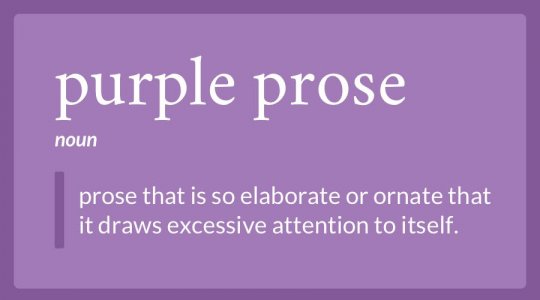
There’s a term for this: purple prose.
It is used to describe flowery, ornate, terribly over-descriptive writing style that makes for a dense reading experience.
There are a few books that can nail this style. Usually, authors that expertly explain a certain niche or highly specific occupation, hobby, or otherwise unordinary setting or situation that could actually use some over-explaining.
Nathaniel Hawthorne often wrote overly dense sentences, but he wrote it richly and intricately in The Scarlett Letter and Seven Gables that practically everyone with a literature degree gave him a pass for it.
You could even make the argument that Frank Herbert embellishes his writing in his classic Dune franchise, but because of how expertly knowledgeable he was in ecology (as well as matters of religion and politics), one can very easily find favor in it.
Among others, E.E. Cummings, Marcel Proust, Ethan Canin, and Victor Hugo were successful ‘purple prose’ writers.
But most of the time, these over-explainers and 20-adjective sentence users may typically confuse and irritate readers more often than please them.
Now, as writers, we don’t always need to be people-pleasers, and not everyone is going to like your style; that’s just something we need to learn.
However, there is still benefit in enhancing the readability of your novel. If even a child can read it and understand it, it’s probably a pretty decent book. Paulo Coelho’s The Alchemist, Ernest Hemingway’s The Old Man and the Sea, Cormac McCarthy’s The Road are all great examples of this.
Not every line has to be described to a T, elegantly penned, or drop some profound wisdom to be masterful writing.
I mean, Shakespeare’s most quoted and most famous line, “To be or not to be?” doesn’t even contain a single word over three letters for f***’s sake.
Sometimes, simple is better.
If you can get readers who aren’t even known for reading to be able to understand your story easily and it’s written in the common vernacular, you’re already winning at the intangibles most books don’t have.
Purple prose – to most agents and editors who will see your manuscript – often screams amateurish, or the need to overcompensate for something.
In some ways, it’s pretentious and self-absorbent, drawing too much attention to itself. I know certain agents who claim they will reject a manuscript immediately if they notice purple prose.
So, yeah, purple prose doesn’t just kill your novel, it torpedoes it into the sun.
 Donovan Levine | Agent, Writer, Copyeditor
Leave a comment