

ROMA is a 2018 drama film directed and written by Alfonso Cuaron about a domestic worker during the tumultuous political climate of 1970s Mexico. You may recognize Cuaron from Children Of Men as well as Harry Potter: Prisoner of Azkaban a.k.a. the only good Harry Potter film.
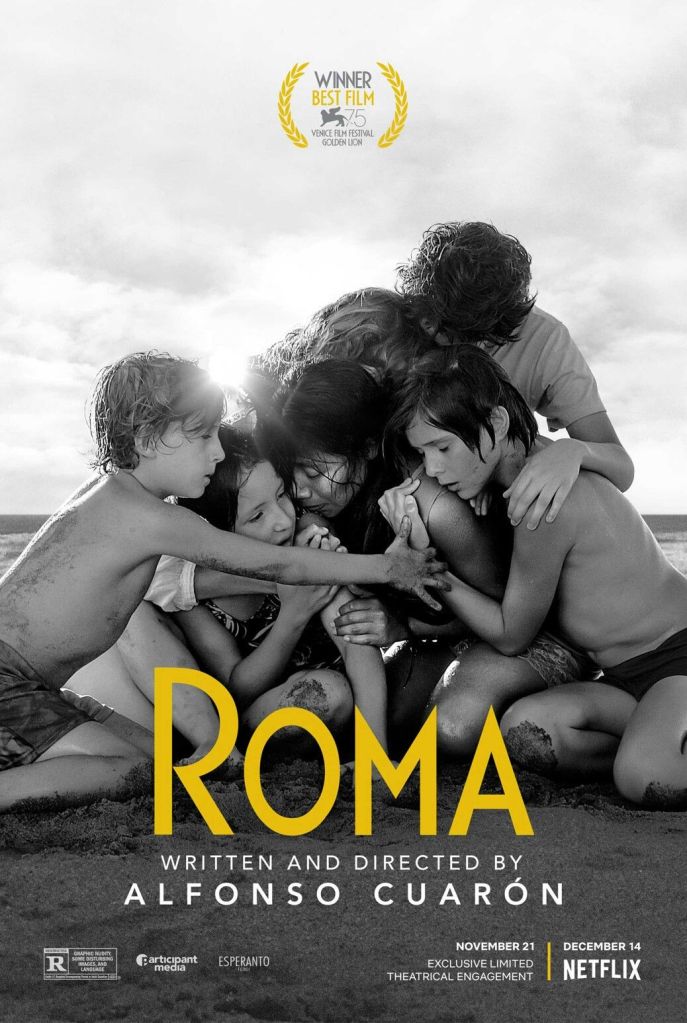
The film won an Academy award for best cinematography and a Golden Lion at the Venice film festival. New York magazine listed it as the best film to not win Best Picture at the Oscars (and I’d have to agree).
So how does a black & white film win best cinematography in this age of 4K resolution, and computer graphics beyond our comprehension, and a plethora of colorful, amazing films that exploded in 2018 (A Star Is Born, The Green Book, At Eternity’s Gate, for example)?
The answer is in the use of lighting, which is important for any film, but actually becomes more apparent in black and white films. The monochromatic effect actually increases depth. Depth of shadow. Depth of field. The atmosphere changes. The mood changes. You’ve heard of mood boards and mood lighting, black & white often feels more tense, more serious, but sometimes even more serene, like a faded memory. Lost time.
That being said, say if you’re a filmmaker or an aspiring director and think you should film in black and white, let me say you should only do it with a very specific reason. Yes, it’s a stylistic choice, but if a movie is black and white for marginally no reason, it’s not going to be well received. Roma, being a historical drama and a nostalgic looking-back-view sort of film from Cuaron’s perspective, this choice makes a lot of sense. Today, you mostly see black & white used in horror films. Kevin Smith used it in Clerks in 1994 to save budget. He’s the only one I can forgive for this choice because Clerks was such a hilarious movie.
The shot selection is beautiful and genius, going as far as to capture a plane moving through the reflection of light from water moving across a tile flooring. Plus, the series of wide shots capture the beauty of Roma and Mexico City.
They most striking scene was the one-shot take of Mexican student protestors repressed by government officers in the streets that dollied into upstairs room of a child crib shop where a paramilitary group prowl the area, one of them being Cleo’s ex-lover Fermin who confronts her while she is pregnant with his child, and her water breaks.
The penultimate ‘beach scene’ where Cleo is embraced by Sofia’s family in the most breathtaking scene of the movie as well as the film’s key visual, is also shot in one solo take.
But the film as an even more psychological effect, by its shots and sounds putting us in a relaxing mood throughout more than a quarter of the film. The atmosphere of this cleaning lady is so serene and perfect. The viewer can practically melt into the scenes and the era of Mexico it portrays. You truly feel as if this is the current time and age of the feature length of the film. The environment of Roma itself is a character.
It’s such a beautiful set up that allows us to be patient with the story and with the character of Cleo, a protagonist who undergoes hardship and trauma and heartbreak during this period of social unrest and great personal fortitude. Our state of mind combines with Cleo’s.
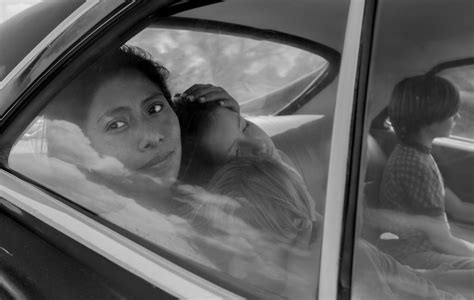
Cuaron gave us a reflective slice of the past, of his own life in fact, as the events of Roma are semi-biographical, detailing the life he grew up in but through the eyes and ears of a maid who’s lost everything and has to carry that weight.
I do find it somewhat disheartening when learning about history at how very little mention there is of the people experiencing these changes and turns and we only get a vague sense of, say.
How the average citizen reacted to the fall of the Soviet Empire or how the Indo-Chinese residents reacted to the incoming migration of European merchants onto their shores. And even among the little mention of these citizens, the lack of women mentioned in social movements and historical turns of the centuries.
History is written by the victors, victors who often attained what they wanted through vile and conniving ways, causing us to ignore and neglect the lives and stories and cultures that once existed and flourished that will be forgotten in history. A lot of textbooks and popular YouTube history channels and history networks usually focus on the leaders and pretty faces of the movement that as a result the John F. Kennedys and Martin Luther Kings of the world take stage more often than the Alice Pauls and Susan B. Anthonys.
It is so important to capture the stories of the ordinary people who lived, so that their culture and lifestyle becomes immortal and not forgotten. It is the reason films such as The Pianist, Iron Jawed Angels, The Great Debaters, First They Killed My Father, Goodbye, Lenin!, Freedom Writers, Under the Same Moon, Awakenings, and several others are such necessary films.
Essentially time capsules that show us the humanity of these eras, the people and the voices who cried out during such periods. Roma really has that same feeling, but the story unfolds in a slow burn, meditative experience that leaves you falling to pieces.
 Donovan Levine | Agent, Writer, Copyeditor
Leave a comment